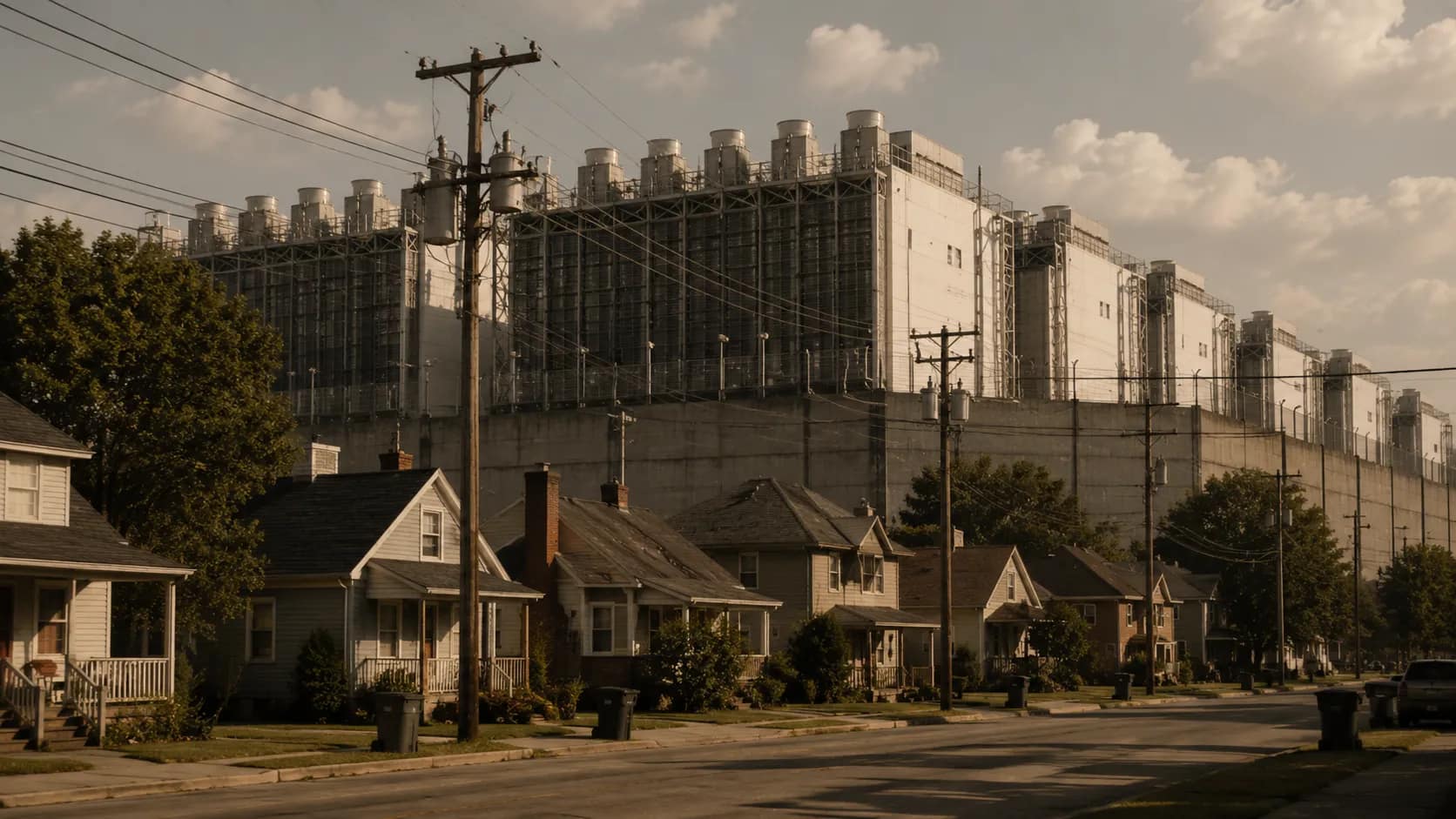
A large data center does not merely occupy land and consume electricity. It can reshape how a community plans roads, negotiates taxes, allocates water, develops its workforce, and imagines its economic future. That makes the modern data-center cluster resemble an updated company town: a place whose infrastructure and public decisions become increasingly organized around one dominant industrial activity.
The analogy has limits. Data centers do not employ entire communities in the same way as mines or factories once did. Their influence comes less from direct employment and more from capital intensity, utility demand, land use, and bargaining power.
The new dependency is infrastructure, not payroll
Traditional company towns depended on a major employer that controlled jobs, housing, commerce, and local institutions. Data-center regions can develop a different dependency. The facilities may employ a relatively specialized workforce, yet their electricity, water, and tax arrangements can dominate local planning.
A municipality may redesign substations, transmission access, fiber routes, roads, and emergency services around expected data-center growth. Once those investments are made, the region becomes committed to the industry's continued presence.
The dependency is therefore embedded in public and utility infrastructure. If demand changes or a project is delayed, the community may still carry planning costs and foregone alternatives.
Local leaders should distinguish between announced capital investment and durable local economic value. A large facility can expand the tax base, but the distribution of benefits depends on incentives, operating costs, employment, and public-service obligations.
Power becomes the organizing resource
Electricity is the central constraint. Large computing facilities require substantial, reliable power and may seek long-term capacity commitments.
This affects other users. Utilities must decide how to allocate generation, transmission, and interconnection resources while preserving reliability and affordability. A data-center project can accelerate infrastructure investment, but it can also concentrate risk if the projected demand does not materialize.
Communities should ask:
- Who pays for grid upgrades?
- Are costs allocated to the project or socialized across ratepayers?
- What happens if the facility uses less power than expected?
- Can capacity commitments be transferred?
- How are peak-demand risks managed?
- Does the project support new generation or only reserve existing supply?
The answers determine whether the facility strengthens the regional grid or becomes a privileged claimant on scarce capacity.
Power negotiations also influence economic development. Regions with available electricity may attract investment, while communities facing constrained grids may prioritize one project at the expense of housing, manufacturing, or other industries.
Water and land create local tradeoffs
Data centers vary in cooling design and resource use, but local debates often focus on water. The issue is not merely annual consumption. Timing, watershed conditions, competing users, and drought resilience matter.
A community should evaluate:
- The source of water.
- Seasonal demand.
- Cooling technology.
- Reuse or recycling plans.
- Emergency requirements.
- Long-term climate stress.
- Reporting and verification.
Land use also matters. Facilities may occupy large parcels near power and fiber infrastructure. Their physical footprint can limit alternative development and alter surrounding property patterns.
Unlike a dense office district or mixed-use industrial zone, a data-center campus may create limited street activity and relatively few adjacent businesses. Economic-development models should therefore account for opportunity cost, not only construction value.
A hypothetical county may approve a large campus on land suitable for advanced manufacturing. The decision could be rational, but it should compare long-term employment, infrastructure demand, tax revenue, and resilience across alternatives.
Tax incentives can redefine the public bargain
Data-center projects often negotiate incentives based on promised investment, tax revenue, or regional competitiveness. The public bargain becomes difficult to evaluate because large headline investments do not automatically translate into equivalent local benefit.
Officials should examine:
- Which taxes are reduced or exempted.
- The duration of incentives.
- Performance conditions.
- Clawback provisions.
- Infrastructure contributions.
- Employment commitments.
- Reporting requirements.
The agreement should account for changes in project scope. A company may build less capacity, delay phases, or change equipment. Incentives should be linked to verified outcomes rather than broad intentions.
Transparency matters because the public may bear indirect costs through utility upgrades, land preparation, or service expansion. Confidential negotiations can make it difficult to compare benefits and obligations.
The company-town analogy becomes strongest when one industry gains disproportionate influence over local policy without equivalent public visibility.
Employment expectations require precision
Data centers create construction work, technical operations roles, security, maintenance, and supporting services. However, the employment profile differs from labor-intensive manufacturing.
Communities should separate:
- Temporary construction jobs.
- Permanent on-site roles.
- Contracted services.
- Regional supplier activity.
- Indirect employment claims.
Workforce programs should be tied to actual positions and skill requirements. Training residents for roles that remain limited or are filled through specialized national recruitment can create disappointment.
The industry can still support valuable technical careers, particularly when clusters include network operations, equipment maintenance, energy management, and related services. The question is whether the local workforce strategy matches the number and type of jobs likely to remain.
Economic-development communications should avoid implying that capital intensity and employment intensity are interchangeable. They are different forms of value.
Community leverage is strongest before approval
Once land, power, and infrastructure commitments are made, local bargaining leverage may decline. Communities should define their priorities before projects become politically inevitable.
Potential community benefits include:
- Infrastructure contributions.
- Workforce programs.
- Local procurement.
- Water-use commitments.
- Grid-support investments.
- Public reporting.
- Environmental monitoring.
- Emergency-service funding.
These commitments should be specific and enforceable. Voluntary promises may weaken when project economics change.
Regional coordination is also important. A company may negotiate with several neighboring jurisdictions, encouraging them to compete through incentives. Shared standards can reduce the risk that communities underbid one another while absorbing similar infrastructure demands.
The public conversation should include residents, utilities, businesses, environmental stakeholders, and institutions that may be affected by resource allocation.
Concentration creates resilience questions
A region organized around one industry can benefit during expansion and become vulnerable during technological or market change. Data centers are physical assets, but the value of specific facilities may depend on power costs, equipment density, network access, regulation, and evolving computing architectures.
Communities should consider:
- Whether facilities can be repurposed.
- Who owns supporting infrastructure.
- How tax revenue changes over the equipment lifecycle.
- Whether local services depend heavily on one taxpayer.
- What happens if future expansion occurs elsewhere.
Diversification remains important. A data-center cluster may support energy technology, construction, networking, and specialized services, but those linkages should be cultivated deliberately.
A municipality that uses temporary revenue to create recurring obligations can become exposed if the tax base changes. Long-term financial planning should stress-test different operating scenarios.
The company-town risk is political as well as economic
Large infrastructure investors can become influential participants in local policy. Their expertise, capital, and urgency may exceed the capacity of smaller municipal institutions.
This can create an information imbalance. Officials may depend on company-provided forecasts to evaluate power demand, employment, or environmental impact. Independent technical review helps correct that imbalance.
Governance safeguards may include:
- Public disclosure of agreements.
- Independent utility analysis.
- Conflict-of-interest rules.
- Periodic compliance reporting.
- Accessible complaint processes.
- Review of cumulative regional impact.
The issue is not that companies should be excluded from planning. It is that public institutions must retain the ability to define policy according to broader community needs.
A healthy relationship treats the data center as one major participant in a diversified regional economy, not as the organizing authority around which every decision revolves.
A better development model is possible
Data centers can support investment, modern infrastructure, technical employment, and a stronger tax base. The company-town outcome is not inevitable.
Avoiding it requires a balanced public bargain. Communities need transparent economics, cost allocation, enforceable commitments, resource planning, and diversification.
The central questions are straightforward:
- What does the project consume?
- What does it contribute?
- Who carries the downside risk?
- Which alternatives are displaced?
- How does the agreement perform under weaker growth?
The modern company town is not defined by rows of employer-owned houses. It is defined by dependence: one industry's ability to shape infrastructure, public finance, and political priorities.
Data-center regions should welcome investment without surrendering strategic autonomy. The goal is not to prevent large computing facilities. It is to ensure that communities remain more than utility platforms for them.
This story follows ourEditorial Policy. Something wrong?Report a correction.
FREQUENTLY ASKED
The comparison concerns dependence rather than direct employment. Data centers can shape power planning, water use, land policy, tax agreements, and public infrastructure. A community may become organized around one industry's needs even when that industry does not employ most local residents.
Officials should compare verified tax benefits, permanent employment, infrastructure costs, resource use, opportunity cost, and downside scenarios. Incentives should include performance conditions, reporting, and clawbacks when promised investment or operating commitments are not delivered.
They can support new generation, grid upgrades, and long-term investment when costs and risks are allocated carefully. They can also strain capacity or shift infrastructure expenses to other users. The outcome depends on power contracts, interconnection planning, and who pays when demand changes.
Communities can diversify their tax base, avoid using temporary revenue for permanent obligations, cultivate related industries, preserve alternative development sites, and negotiate enforceable public benefits. Regional cooperation can also reduce incentive competition between neighboring jurisdictions.